
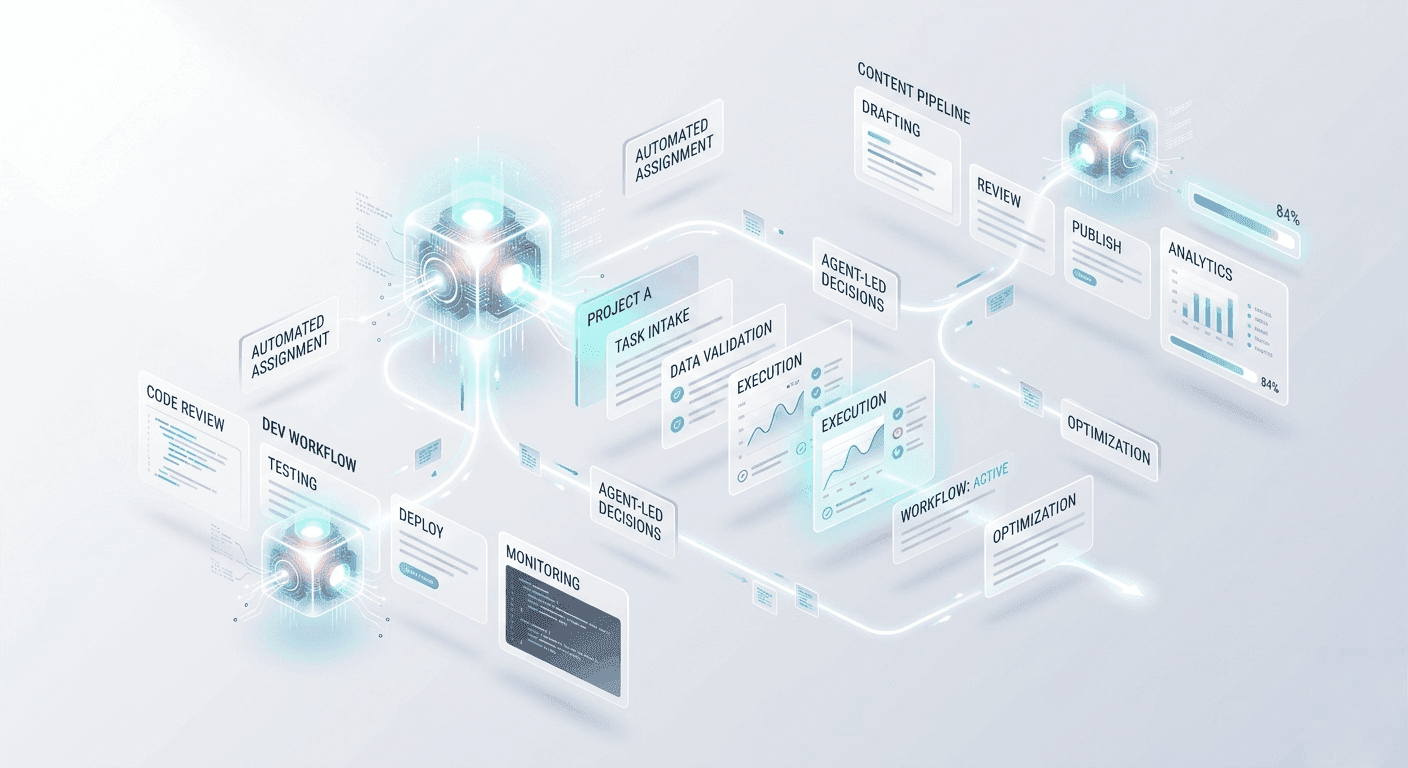
Artificial intelligence has moved far beyond answering questions or generating text. In 2026, a new generation of systems known as AI agents is beginning to reshape how work gets done across industries.
It's not like traditional AI assistants that respond to prompts, AI agents can plan tasks, use tools, make decisions, and execute multi-step workflows autonomously.
This shift represents one of the most significant changes in the history of software.
Instead of simply helping people complete tasks, software is increasingly capable of doing the work itself.
From AI Assistants to AI Agents
Over the last few years, most people have become familiar with AI assistants.
These systems can:
- answer questions
- write code
- summarize documents
- generate images
However, they typically rely on direct human instructions for every step.
AI agents operate differently. They are designed to:
- receive a goal
- break that goal into smaller tasks
- execute those tasks using tools
- evaluate the results
- iterate until the goal is achieved
AI agents don’t just respond to instructions — they pursue objectives.
This capability is what makes them particularly powerful.
What Is an AI Agent?
An AI agent is a system capable of performing tasks autonomously by interacting with its environment, tools, and data sources.
In practical terms, an AI agent can behave like a digital worker that completes complex workflows.
Core Characteristics of AI Agents
| Capability | Explanation |
|---|---|
| Goal-oriented behavior | Works toward a defined objective |
| Planning | Breaks tasks into smaller steps |
| Tool usage | Interacts with APIs, software, and data |
| Memory | Remembers previous context and results |
| Iteration | Improves output through repeated cycles |
These capabilities allow AI agents to handle tasks that once required multiple human steps.
How AI Agents Actually Work
Behind the scenes, most AI agents follow a structured execution loop.
The process usually looks something like this:
Goal → Plan → Execute → Evaluate → Improve
Step 1: Define the Goal
A user provides an objective, such as:
- “Research competitors and summarize findings”
- “Analyze sales data and identify trends”
- “Build a prototype landing page”
Step 2: Planning
The agent generates a step-by-step strategy for completing the task.
Step 3: Execution
It begins performing actions, which may include:
- browsing the web
- writing code
- querying databases
- interacting with software tools
Step 4: Evaluation
The agent checks whether the results meet the original goal.
If not, it modifies its approach and tries again.
This self-improving loop makes AI agents powerful.
Examples of AI Agents Emerging Today
Several experimental systems are already demonstrating what AI agents can do.
Development Agents
Some agents specialize in software engineering workflows such as:
- writing code
- debugging programs
- running tests
- deploying applications
These systems can sometimes complete multi-step development tasks automatically.
Research Agents
Research-focused agents can:
- search the web
- gather data
- summarize reports
- produce structured insights
This dramatically speeds up information gathering.
Automation Agents
Automation agents connect to digital tools and services to perform tasks such as:
- sending emails
- generating reports
- updating spreadsheets
- managing workflows
Businesses are beginning to experiment with these systems as digital operations assistants.
Industries Already Experimenting with AI Agents
AI agents are still emerging, but several industries are already exploring their potential.
| Industry | How AI Agents Are Used |
|---|---|
| Software Development | Automated coding, debugging, testing |
| Finance | Data analysis and reporting |
| Customer Support | Intelligent service automation |
| Marketing | Campaign creation and analytics |
| Research | Automated information gathering |
While these systems are not yet perfect, they show how software could evolve into autonomous digital collaborators.
Why AI Agents Matter
The impact of AI agents extends far beyond automation. They change how humans interact with software. Traditional software requires users to manually navigate interfaces and execute commands.
AI agents reverse this relationship. Instead of telling software how to do something, users simply define what they want to achieve.
The future of software may revolve around goals rather than interfaces.
This shift could fundamentally change how productivity tools are designed.
Challenges and Limitations
Despite their promise, AI agents still face significant challenges.
-
Reliability: Agents can sometimes make incorrect assumptions or produce inaccurate outputs.
-
Safety: Autonomous systems interacting with tools and data must be carefully controlled.
-
Oversight: Human supervision remains important, especially for complex or sensitive tasks.
-
Technical complexity: Building reliable agent systems requires sophisticated infrastructure and monitoring.
Because of these challenges, most organizations currently treat AI agents as assistive technology rather than fully autonomous workers.
The Future of AI-Driven Workflows
Looking ahead, AI agents may become central to how digital work is performed.
Possible developments include:
- AI agents collaborating with human teams
- personal AI assistants managing daily workflows
- automated research and reporting systems
- autonomous development pipelines
Instead of replacing human expertise, these systems may allow people to focus more on creative and strategic work.
AI agents are a good example of this shift. While the technology is still developing, they show us a powerful idea: software may soon do more than just help us-it may actually work alongside us to reach complex goals.
For developers, businesses, and creators, understanding this change could be important for navigating the next era of artificial intelligence.
Read more

Adobe + NVIDIA Partnership: How AI Is Reshaping Creative Workflows in 2026
Adobe and NVIDIA have partnered to redefine AI-powered creativity, marketing, and production. From smarter automation to 3D digital twins, this collaboration signals a major shift in how content will be created and scaled in the future.
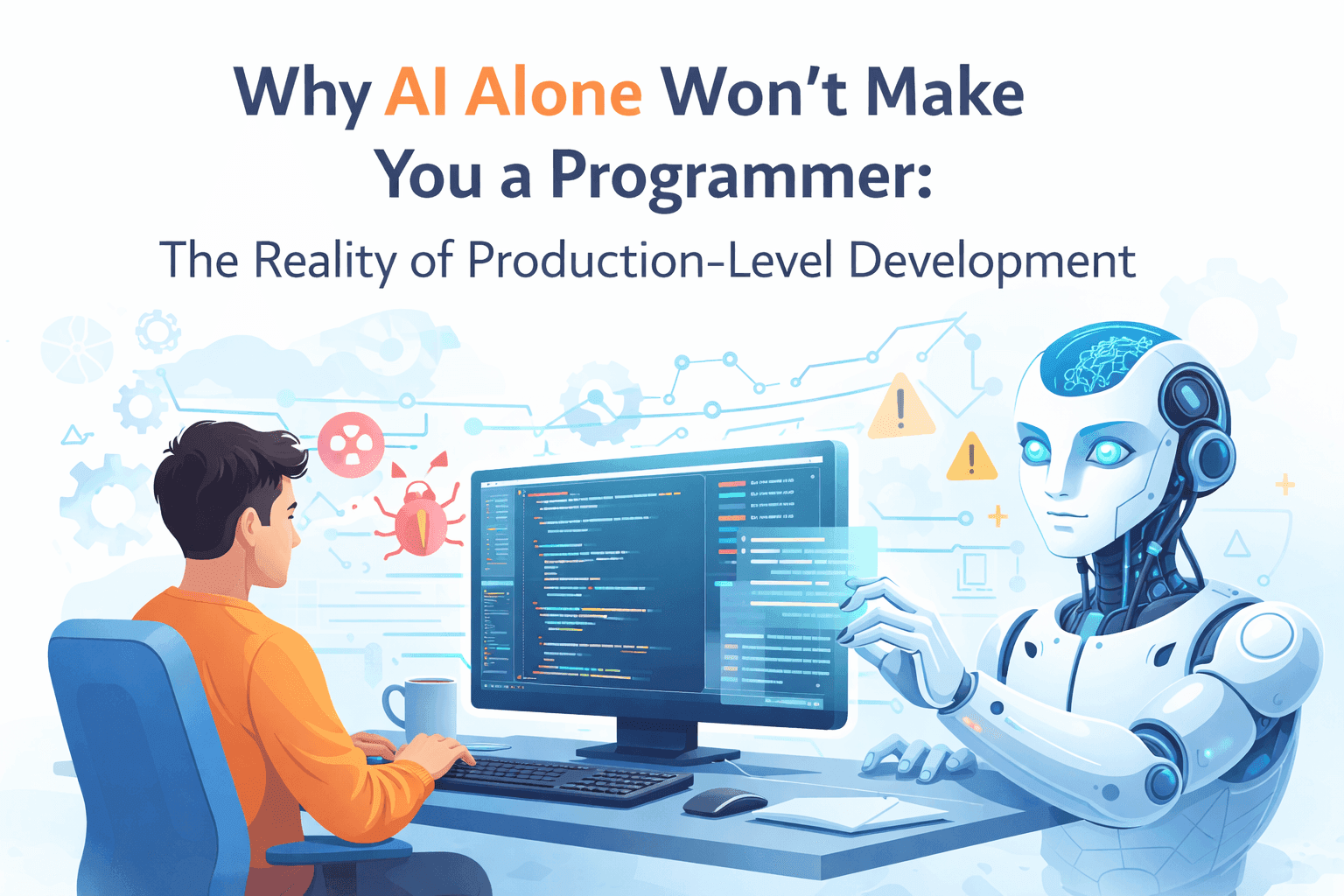
Why AI Alone Won't Make You a Programmer: The Reality of Development
With the rise of sophisticated AI models, there is a common misconception that "anyone can code now." While AI is a revolutionary helping tool, the gap between generating a snippet of code and building a professional, production-level application is vast.